
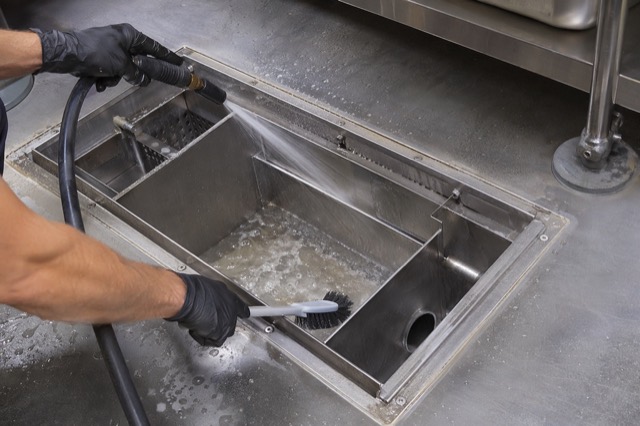
Drainage and Sanitation / 01
Check the tank’s condition and cleaning scope
The work method and duration vary depending on the tank’s size and number of compartments, how the lid opens, the basket and baffle design, and the amount of grease and residue. When asking about cleaning, gather what you can about the tank’s location and shape, the date it was last cleaned, and how it is managed day to day.
Cleaning a grease trap and cleaning drain pipes or downstream equipment are not necessarily the same job. When reviewing a quote, confirm the scope, how sludge, waste oil, and other materials will be collected and disposed of, and what the post-work report will cover.
- Tank and Basket
- We check the number of tiers, dimensions, whether parts can be removed, and whether there is any damage.
- Dirt and buildup
- We check grease, residue, odors, and recent cleaning records.
- Work conditions
- We confirm business hours, removal routes, water access, protective covering, and access requirements.
- Collection and disposal
- We confirm in advance what will be collected, how it will be processed, and what is included in the cost.
Drainage and Sanitation / 02
Separate Routine Maintenance from Specialized Work
Routine tasks such as cleaning the basket should be carried out in accordance with the store's hygiene procedures and the equipment operating instructions. Avoid entering the tank, reaching deep inside in an unsafe position, mixing chemicals, or disassembling equipment without authorization. Contact a specialist contractor if needed.
Cleaning frequency depends on the type of cooking, wastewater volume, tank structure, and store operations. Rather than setting an arbitrary, one-size-fits-all schedule, review the condition of the buildup and cleaning records, and check your store’s hygiene management standards and guidance from local authorities and other relevant bodies.
Drainage and Sanitation / 03
Use consistent record fields across multiple stores
When head office manages multiple stores, it is easier to compare them if you record the store name, the location and structure of the grease trap, cleaning date, scope of work, observed issues, and items to check next time in a consistent format. Keeping records does not in itself guarantee sanitary conditions, but it provides a basis for confirming the request details and changes since the previous service.
When you contact us, please share a list of the stores, your preferred timing, each store’s access and business hours, and how responsibilities are divided with existing providers. We will advise whether work can be carried out at all stores and on what schedule after confirming the region and conditions.
FAQ / QUESTIONS
Frequently Asked Questions
Are drain pipes also cleaned when the grease trap is cleaned?
Cleaning inside the grease trap and cleaning the downstream drain pipes may be separate scopes of work. When requesting an estimate, confirm which areas are included and excluded.
Can cleaning frequency be set uniformly?
The appropriate frequency varies depending on the food being prepared, wastewater volume, tank structure, and store operations. Refer to cleaning records and how grime accumulates, and also check the store's hygiene management standards and guidance from local authorities and other relevant bodies.
The information presented is general guidance to help organize the conditions at your store. We will advise on whether work can be carried out, the method, and the cost after confirming the equipment specifications, contract, region, and on-site conditions. In an emergency or if there is a hazard, follow the store’s official safety and hygiene procedures and the facility manager’s instructions first.